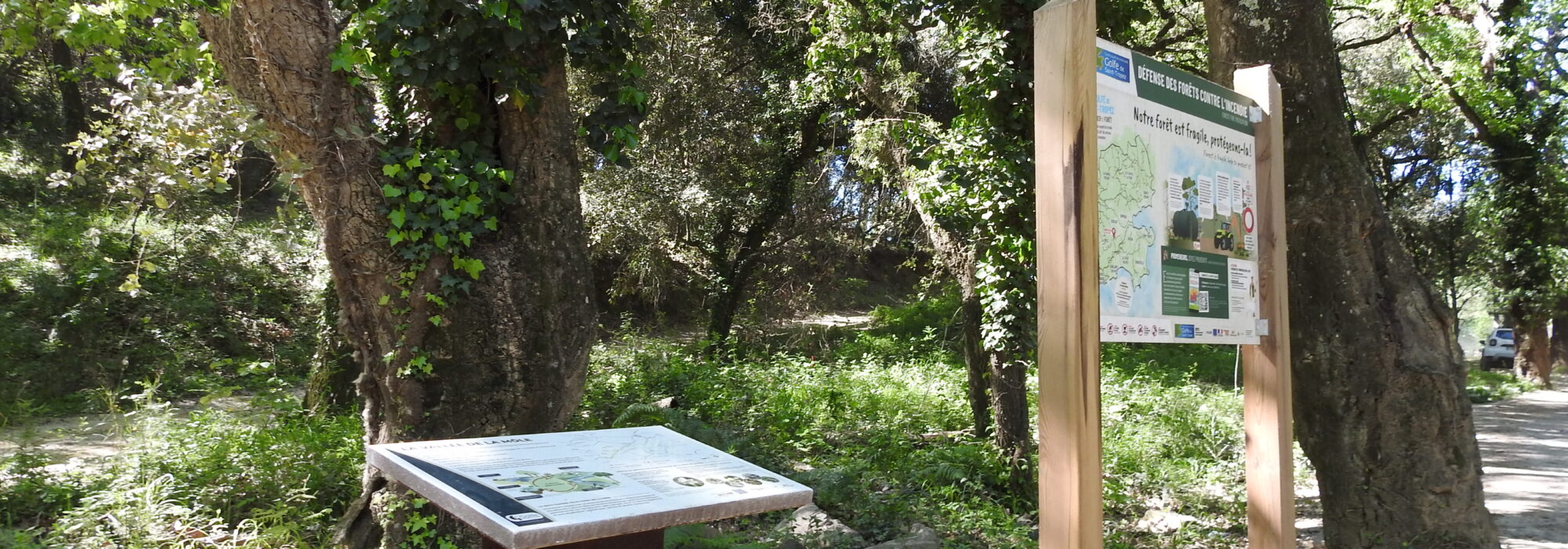
What if we told you about turtles?
Two turtles live in the Maures massif: the Hermann’s turtles, terrestrial, and the European pond turtle, aquatic. They are both protected because their populations are declining. If you encounter any, let them continue on their way, they are not lost.

Hermann’s turtles
In the heart of the Maures massif, in the dense maquis and semi-open forest areas, this land turtle is at home everywhere and is perfectly adapted to this natural environment.
It is essentially herbivorous and feeds on more than a hundred plant species. It is in her natural environment that she finds everything she needs and where she is the happiest turtle.
Maximum size: 15 to 20 cm
Maximum weight: 700g to 1kg
Lifespan: 30 years on average. Specimens have reached 80 years old
The breeding period extends from March to May, with egg-laying between April and May. The eggs remain buried for 70 to 90 days.
The temperature of the ground determines the sex of the future little turtle – below 29°C males will be born; above 31°c they will be females; between the two males or females will hatch.
During the coldest periods, from November to March, the Hermann’s tortoise hibernates.
During the hottest periods, when temperatures often exceed 35°C, this turtle also slows down its metabolism and protects itself from extreme heat by sheltering under leaves and humus. This period of rest is called aestivation.
When they hatch in September, the little turtles measure: 3 cm and weigh 10 g. They have two months to feed and prepare for their hibernation which will take place between November and March.

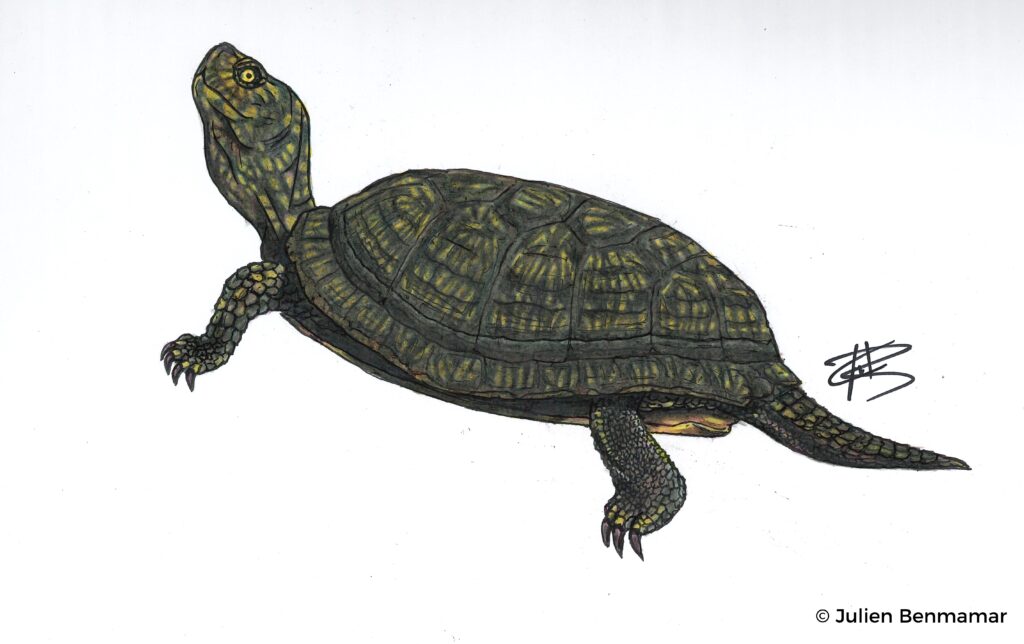
The European pond turtle
It lives in humid areas with fresh, calm water and plenty of sunlight. Like its cousin the Hermann’s tortoise, the pond turtle has found happiness in the Maures massif.
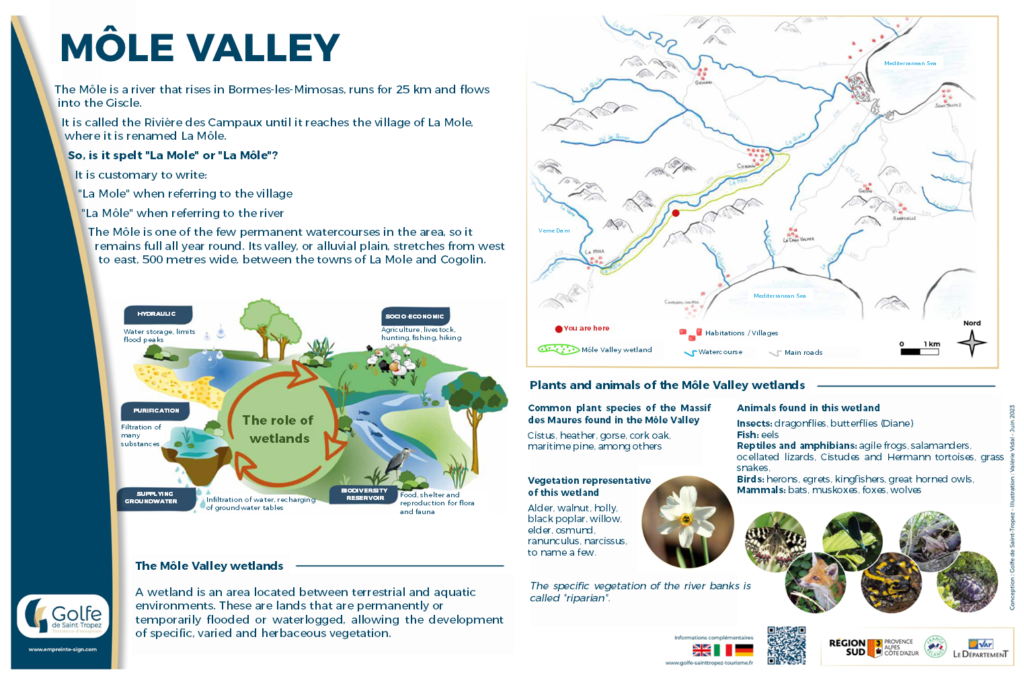
Concerning the point where you are, the banks of the Môle are a perfect habitat for it because it finds areas of calm water and small sandy beaches to bask in the sun. Maybe a bit like vacationers?
It is a discreet and shy little turtle. She will dive into the water at the slightest sign of warning. To see it, be calm and silent.
It readily feeds on dead fish, but also on live animals such as worms, molluscs, aquatic insects and crustaceans.
Its shell is oval and slightly convex, olive green to black in color, with small yellow dots or streaks. The rest of its body is black punctuated with yellow spots. Its feet are webbed and have powerful claws that facilitate movement in water and on land.
Maximum size: 20 cm
Maximum weight: 600 g to 1.3 kg
Lifespan: 50 years. Individuals have reached 100 years
It reproduces in water in spring. At the end of spring, females bury their eggs in the ground and far from water sources.
The temperature of the ground determines the sex of the future little turtle – Below 28°C males will be born; above 28°C they will be females.
The young Cistudes hatch at the end of summer. They measure less than 2 cm and their shell is soft. They are therefore very vulnerable and are prey to foxes, birds, hedgehogs, etc.
They quickly prepare for hibernation.

The wetland
You can also find additional information on the wetland, its functioning, its roles and interests, on the website of the Maison Régionale de l’Eau. Located in Barjols, this institution plays an essential role in environmental education and the promotion of sustainable management of water resources.
To find out more, go here

